
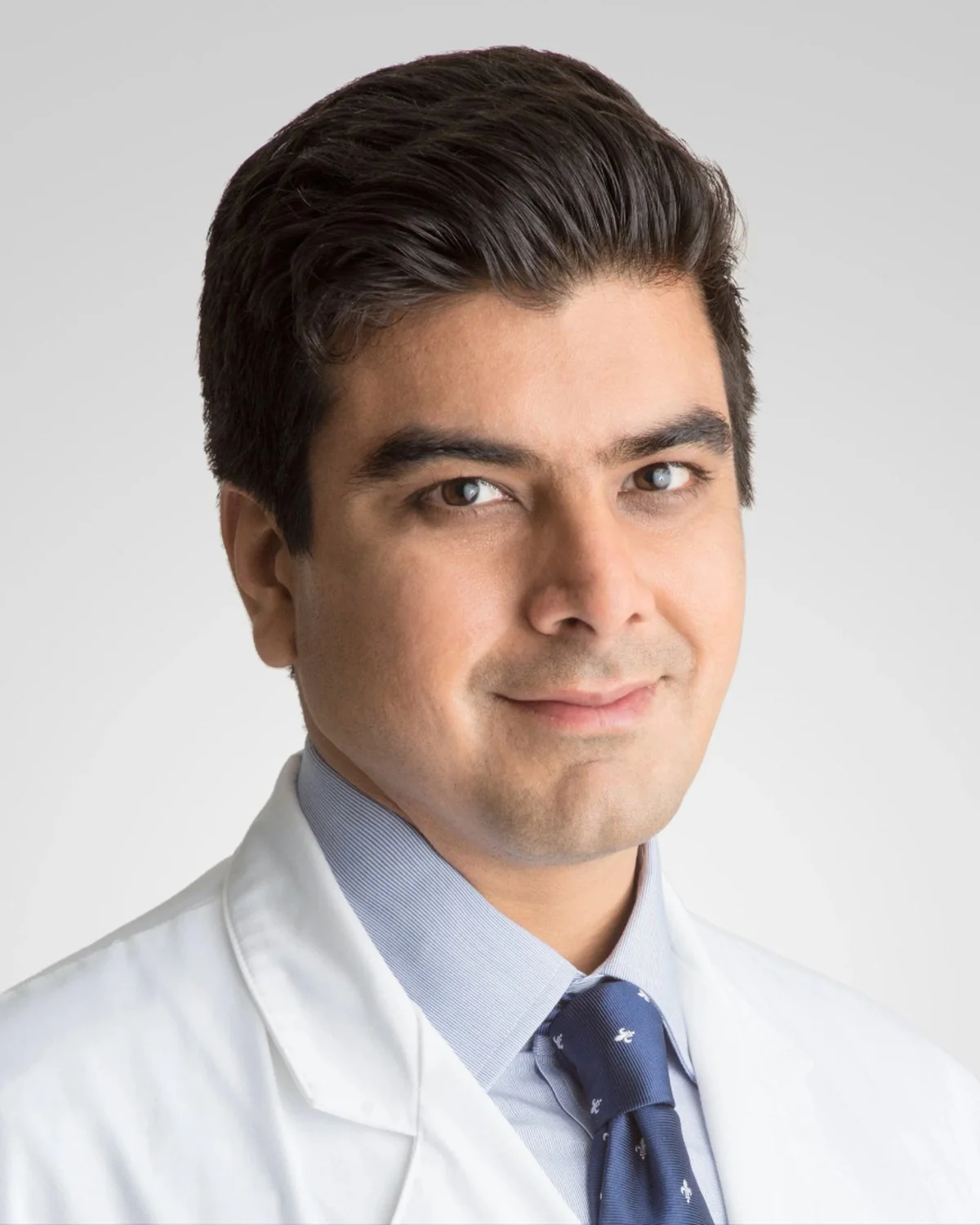
Dr. Karan Johar is a New York physician whose career is built on one question: how to restore function and relieve pain with the least invasive treatment that works. He is board-certified in Physical Medicine & Rehabilitation and in Pain Medicine, and has more than fifteen years of experience in medicine.
Training
Johar studied financial economics at the State University of New York at Binghamton before earning his MD at Ross University School of Medicine. He completed an internship in general surgery at Stony Brook University, his residency in Physical Medicine and Rehabilitation at Washington University in St. Louis and Barnes-Jewish Hospital, and a fellowship in pain medicine at the Medical College of Wisconsin.
Practice and teaching
Today he practices at Park Avenue Medicine & Surgery at 993 Park Avenue, with affiliations at NYU Langone, Lenox Hill Hospital and the Manhattan Eye, Ear and Throat Hospital. His work focuses on minimally invasive spine care and on regenerative medicine, including platelet-rich plasma (PRP) and autologous cell therapy, alongside neuromodulation for complex pain.
He is an Adjunct Clinical Assistant Professor at NYU Langone and co-directs the Manhattan Pain Medicine Fellowship Program. Over his career he has taught residents and medical students, mentored more than a hundred pain physicians from around the world, and lectured as a visiting professor and keynote speaker in seven countries. He is a national speaker and key opinion leader in his field.
A community of physicians
Johar is CEO and President of the New York Physician Society, a community of physicians, specialists and health technologists that brings its members together through education, business and culture, including galas in New York. He also serves on the young physicians board of the New York County Medical Society and as a director-at-large of the New York chapter of the American Society of Interventional Pain Physicians.
On the TOP USA jury
Aesthetics is medicine first. Injectables, regenerative treatments and surgical procedures all rest on the same clinical foundations of safety, evidence and patient care, and PRP, part of Johar’s own field, is widely used in aesthetic practice today. He brings that clinical standard to the jury, together with long experience of evaluating, training and leading physicians, and will weigh every candidate on the same six measures as his fellow jurors.